

Blagetty Blogetty Bragitee!

My Photo
Name:
Location: United Kingdom

Some people know me as OrangeBlossomer because that's me on Twitter. This blog is a random collection of daily musings about life and stuff I love, such as journalism, dog (sadly my dog died in 2010 so probably no more), women, love and lack of love, boobs (only seldom but it does get me extra online traffic), taichi (I practise) and spirituality (should practise more). I have a day job as a jetsetting publishing foreign rights manager but I am also an NCTJ-qualified journalist and a writer/columnist at heart. Writing is my opium.

Friday, 20 May 2011

Potholes and dog poo: is this the future of journalism?
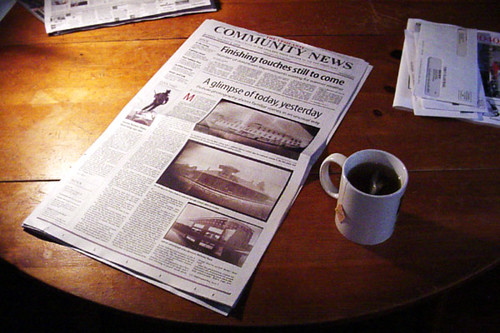
Newspaper and tea
Photo courtesy of Matt Callow
"I don't care about local news."

The bold statement 'The Chancer', one of the journalist graduates from The Wannabe Hacks blog, made in a post about local journalism failing to engage young people attracted a string of of angry comments from several journalists, who called his argument "parochial", "naive", "ridiculous and lazy".

Knowing the power of the Internet in helping employers hire and fire, I was astounded that a young graduate, who "wanna be a hack", should have exposed such eyebrow-raising views in a public forum. His views, however, are far from being unique.

I live in a small, low-average-income town, where, I am certain, young people also think the local paper is only good for wrapping fish and chips. Apart from a few pubs and gambling places, our high street does not offer particularly attractive young leisure options. Not surprisingly, vandalism is a common local occurrence.

A large Christmas tree put up in the high street at the end of last year was tied to a security camera pole to prevent theft. Despite the effort, within 24 hours, its decorations had been stolen and destroyed. No one was even shocked but it filled me with rage and contempt. What had happened to community spirit? Where was the feeling of belonging and wanting to make things better?

Not all young people are apathetic of course. And not reading the local paper doesn't make you into a vandal either. The Chancer, as far as I know, is a law-abiding citizen, but his lack of interest in the local goings-on reflect that of a vast number of young people across the country. They do not feel a tie to their local area. They do not yet have social responsibilities that can be affected by local politics, local tax, local rubbish collection.

We can berate the wannabe hack for his flawed argument but not for his brutal honesty.

Local news readers
The editor-in-chief of my local newspaper recently extolled the importance of the paper in a double-page spread commemorating Local Newspaper Week (9 - 15 May).

He said the local voices that get heard through the paper represent "the bedrock of any democracy". The Prime Minister's also sent in a message reminding readers local papers help "hold the powerful to account", and former Guardian editor Peter Preston, concludes his column with: "Prize it, relish it, support it, because [..] it helps your world go round."

Democracy? Accountability? World spinner? When I stare at one of our local papers' front page story, and see a Yorkshire Terrier being hailed 'a hero'...for having barked – thus alerting his sleeping owner to a fire, the temptation is great to sneer at these idealistic concepts. 

Right, let's face it. The general pattern tends to be: a couple of larger stories from neighbouring towns, a smattering of nibs about local events and meetings; rehashed press release material, an OAP's 90th birthday, someone running for charity. All in all, fairly sleepy, polite news. An occasional death or crime thrown in for good measure.

Yet, if you look at the Letters page, you will see many locals and local politicians, have read it and written in with their say about an environmental issue, rubbish and bins, about cycle paths, or the lack of them, about dangerous potholes and annoying dog poo fouling the streets.

Whether the young are listening or not, this is their town, their community, their home – they do care. And as long as someone cares, journalists have a duty to fulfil.

Yes, there is room for improvement. Some decent subbing would not go amiss for starters – spelling and grammar in our local paper are often embarrassingly atrocious – and reporters could do with replacing lame press release rewriting with more footwork. But at the end of the day, no matter how good the writing is, papers still need advertising income, still need to sell copies. The question is how.

Dog shit and the future of news
I had hoped some kind of magic formula combining digital + (hyper)local + monetisation could be the answer. But when even the excellent Guardian Local initiative announced its closure for being 'unsustainable', my heart sank. What next then?

Talking at the Brighton Future of News earlier this week, Guardian data journalist James Ball pointed out that a street-by-street mapping of local crime is something no newspaper seems to be recording, but, if one was available, it could generate massive reader interest.

A light bulb went on over my head.

Could using data creatively be one of the solutions? Data visualisation is innovative, exciting and appealing to the eye. It is a fun way to tell a story with pretty pictures – much like a graphic novel – although it is still up to the journalist to find the story in the data.

Most importantly, it could engage younger readers, like The Chancer, who might just take a bit more interest in the local news. Of course this would still imply a migration from print to digital, but more eyeballs on local news can't be a bad thing.

At the BBC Social Media Summit (hashtag #bbcsms on Twitter) this week, Will Perrin founder of Talk About Local mentioned a North London local site, which, despite being run at only £8/month, attracts the equivalent proportionate audience as BBC's Newsnight – even though, in his words, it is fundamentally about "crime, potholes and dog shit". [Watch the video on the BBC College of Journalism site (26min in)]

Will Perrin's words convince me even more that journalists discussing the future of local news should be more concerned about format, presentation and delivery, a little less about local content, which although spurned by the young and the apathetic, still seems pertinent.

In my amused perverted mind, I am imagining a Google Map of dog fouling with pet owners' names against turd-shaped placemarks to name and shame offenders. It wouldn't work in real life, but it would certainly grab readers' attention and provoke mirth.

BBC's Dave Lee's tweet below says it all. We could spend a lifetime debating the future of news and local journalism, but the answer, I suspect, is already right here, at our feet. Quite literally.


Labels: , , , , , , ,

Saturday, 26 March 2011

The Japan quake wall of shameful journalism: are you on it?


Last week I wrote a piece for The Media Blog about Fox News' hilarious blunder in having included a trendy night club in central Tokyo on a map of nuclear reactors in Japan. 

But examples of poor journalistic practice may not always amuse, especially when they can dramatically influence the public's sense of vulnerability or distort perception of a delicate reality, as in the case of Japan's recent earthquake. 

Andrew Woolner, a former IT worker resident in Yokohama, was so appalled by the poor reporting on the earthquake and its aftermath causing unnecessary panic among foreigners in Japan, he felt compelled to create a black list called "The Journalist Wall of Shame", as he explains in his blog

The wiki invites contributors to name and shame the worst offenders among the world's media organisations for their sensationalist or misleading coverage.

Earlier this week its bad journalism list had received at least 180 (unedited) entries from the US, UK, Australia, France, Germany, Spain, Belgium and Italy. A separate section Woolner subsequently added for good journalism had 34 entries at the time of writing.

Woolner's original idea was to gather only a few examples of particularly bad journalism with his friends on Twitter and make individual complaints. He told me by email:
"I never thought it would get so big"
Below are three examples of poor/sensationalist journalism from the UK that have been entered on the shaming list:
  1. The Sun: Starving Brit Keely: My nightmare trapped in City of Ghosts – Tokyo -the headline says it all. Starvation? Zombies? Ghost Town? Pleeeeze.
  2. The Star: Rosie DiManno's No Escape Valve for So Much Grief - nauseatingly and gratuitously melodramatic, and condescending towards the Japanese. 
  3. The Mail Online: UN predicts nuclear plume could hit US by Friday... Starts with mentions of "terrified passengers packing Tokyo airport" and predictions that the toxic plume would "head into Southern California [...], Nevada, Utah and Arizona" only to later contradict itself by stating that the US Nuclear Regulator Commission had said "it expected no harmful levels of radiation would reach the U.S. from Japan".
Even the data visualisation in Randall Munroe's Radiation Dose Chart, although well-intentioned, doesn't help contain the panic many are experiencing from possible exposure to harmful levels of radiation. Compare it to this chart by the National Institute of Radiological Sciences, or Tokyo Electric Power Company's, which provide a similar visualisation – in context.

For us, living outside Japan and looking in through the tinted glasses of western media, it is difficult to gauge the real mood of those who are inside. 

Judging from the exasperated anti-media messages I have been seeing on Facebook from expats living in Japan, I fear the reality may differ significantly from what has been reported in the press. One of my personal friends, an American currently working in Tokyo, wrote on his Facebook 'wall': 
"No disrespect to the people that have left - but this is turning into a farce. I hope somebody holds the media responsible when it finally fizzles out."
Woolner deserves accolade for doing exactly that – holding journalists to account – but he is realistic about what his "Wall of Shame" can achieve.
"I don't think the work we've done will necessarily make a big difference, but If we can at least get people to start being aware of the problem, maybe there's hope."
Being ethnically Japanese and having lived in Japan for many years, I admit to having, at times, allowed strong emotions to cloud over my objectivity while watching events unfold in the country the past few weeks. But the journalist in me agrees that, as in any other profession, we should never forget the lasting impact the quality of our work will have on any community, large or small.

As Woolner said:
"Bad journalists [...] are like bad doctors [...], bad soldiers, and bad firemen [...]; they make the world a worse place to live in."
***************
If you would like to help the victims of the earthquake in Japan, please click on this this link, where you will find a list of organisations (scroll to the end of that page) you can donate to in your geographical area. Andrew Woolner, as promised!

Labels: , , , , , ,

Thursday, 20 January 2011

From blogger to Guardian reporter: deconstructing Josh Halliday's x-factor


Josh Halliday at Brighton Future of News Group
(photo by Sarah Booker)

The Brighton Future of News Group (BFONG)'s 10th meetup registered record attendance last Monday when around 35 members gathered in the function room at The Eagle in Brighton. There was a buzz of anticipation in the air.

They had come to listen to much hyped young journalist Josh Halliday talk about his success story from graduation from the University of Sunderland straight into a junior reporter job at The Guardian, no less.

At the News Rewired event last June, the 22-year-old media and technology reporter was one of four journalists mentioned by MSN UK's executive producer's Peter Bale in his keynote speech for their success in building their own 'brand' online. The other three mentions were Jemima Kiss from The Guardian, Robert Andrews, editor of paidContent UK and Will Perrin of Talk About Local, all of whom older and more experienced than Josh.

Find your inner brand
Notice the use of the word 'brand'.

To be able to stand out in a crowd and increase your chances for work, a degree, a polished CV and a few months of work experience thrown in for good measure no longer suffice. Being aware of one's strenghts and portraying them to the world in a distinctive way – in other words, establishing, and marketing, your identity as a journalist – is the best cover letter you could ever present a prospective employer. Are you  leaving a mark wherever you tread? Are you getting the right type of attention by the right group of people?  

Because there are far more graduates each year than there are jobs, "you need to do something to get ahead", Josh advises.  And at an age when digital permeates every section of the media world, having a blog, a website or, at the very least, a social media presence seems like an obvious card to have up one's sleeve, the 'edge' over the competition. 

Josh thinks even Dan Sabbagh was discovered and landed his job as Guardian's Head of Media and Technology, less because of his credentials at The Times than his 'extra-curricular' activities online – his news site Beehive City

It is worth remembering Joanna Geary, community editor of The Times, famously received a job offer on Twitter. Josh promoted his SR2 hyperlocal blog, which got him noticed by other journalists and eventually his future employers, also entirely on Twitter. He joined the microblogging site in December 2008; the following year he was already employed by The Guardian.

Former head of digital development at Telegraph Media Group, Greg Hadfield, a frequent attendee of the BFONG meetings, calls the phenomenon "the new fast track for journalists to success".

Rules of engagement
But Twitter does not always work as a 140-character notice board for jobseekers, nor does it replace traditional job search routes. Twitter, social media sites and blogs are mere tools. As with any tool, the outcomes will depend on whether you know how to use them.

The success of Josh Halliday's SR2 blog and the effectiveness of his brand can be attributed to a simple skill anyone can learn: knowing how to engage with people

His tips for the Brighton Journalist Works' students, who will be covering their own patches as community reporters, were crucially centred round communication with people: making friends with the local policeman, searching for tweeterers in the local area, replying to their questions about the nearest dry cleaner's. Building personal relationships, a skill universities do not necessarily teach, could determine whether you get to that breaking piece of news first, or not.

Dialogue

Several local journalists, including former Argus reporter Richard Gurner, talked proudly about the privilege of being able to "enter people's lives" as a journalist. "It is a key reason to be a journalist," he said. As a local reporter working under pressure, going out to meet people everyday was not always possible. 

Joel Gunter, sub-editor at Journalism.co.uk, pointed out that, if you work for a smaller site, engaging with people through (moderated) comments left on news articles online, can compensate for the lack of direct contact with one's audience. 

Old-school print journalists may be struggling with the very concept of having one's piece commented on by readers, let alone engaging in dialogue with them, but I doubt dinosaurs will survive the digital revolution in media.

Journalism in the 21st century thrives on two-way communication. News, particularly online, is no longer static and final; instead it can evolve with the audience.

 
Special
Watching the feel-good effect Josh Halliday seemed to have on the BFONG crowd I asked myself what this young hack's pulling power really was about, apart from being so young yet so enviously successful?

Skimming the attendees' comments on the meetup page, I notice the word "unassuming" appears more than once. I must admit that is also the quality I most admire in Josh: his modesty, his feet-on-the-ground attitude, the refreshing balance of a mature head on a young body. Despite all the public accolades received, he retains perspective and a genuine sense of wonder about the world in general.

My highlight of the evening was when Greg Hadfield asked him: "Where do you see yourself in five years' time?" The audience laughed, then held its breath in expectation. Unlike most journalists, who start their careers covering council meetings at a small regional newspaper and work their way up the Fleet Street ladder, where can one aim to go after a job at The Guardian at the age of 22?  

Josh's reply was unexpected and made me gasp for its disarming candidness: he would love to do what he enjoys the most, i.e. being a local reporter...

Perhaps the shortcut to success then is staying true to one's heart, no matter where one is in the journey. For that alone, Josh Halliday has a captive audience in me.

Join BFONG
BFONG organiser Sarah Booker's live blogged the event here, and I tweeted under the usual hashtag #bfong. For news and reminders about future meetups follow @brighton_fong on Twitter or join the Brighton Future of News group. The group is open to all and attendance is free.

Labels: , , , , ,

Friday, 9 April 2010

Navratilova's cancer: why the media failed to score

The announcement this week that legendary tennis champion Martina Navratilova is undergoing treatment for breast cancer has made headlines in practically every newspaper and website.

On checking the front pages of the national newspapers and web-based reportage yesterday I couldn't help noticing almost all of them used cliched words such as "battle", "struggle", "suffer". This is exactly the kind of vocabulary my sub-editing tutor advised us not to use, as they risk portraying a disease as something more dreadful than it may actually be.

Yet this is how some of the nationals headlined the story on 8th April:


Headings scream

The Daily Express: Martina fights breast cancer


The Daily Mail: Martina's breast cancer battle


The Daily Telegrpah: "I will win cancer fight, says Martina."


The Indie: Navratilova's new battle

It is easy for a story to end up magnified in the media when it is linked to a famous person, such as Martina Navratilova.  But looking at some of the more sensationalist headlines made me question what the best and correct way of reporting the story of someone's serious disease might be. 

Red lipstick gone wrong

At at time when newspapers struggle with a falling readership, 'bigging up' a story to make it more saleable might even fall within the forgivable remit of a sub-editor's stylistic licence. But an Antipodean news website had the bad taste of calling Navratilova a "cancer victim", even when prognostics of a complete cure for her early-stage, not invasive ductal carcinoma in situ (DCIS), confined to the milk ducts, has been reported to be "excellent". 

Do journalists really think all cancer patients consider themselves to be cancer victims? It concerns me that language better suited to obituaries end up being used in headings to announce someone is merely ill.


As a loyal Guardian reader, I felt proud that its subs had chosen the heading" 'My 9/11' Navratilova's cancer" – understated and to-the-point, yet still emotive, with Navratilova's quote providing just enough dramatic impact.

The Guardian: Navratilova's cancer


Headlines and captions must grab the attention of the reader, of course, but try too hard and it turns into that dangerously bright red lipstick that makes a woman look more like a hooker than a sex goddess.

Tragedy vs. tragic words
Examples of headlines that scream tragedy and scandal at the reader abound in our papers. I happened to pay particular attention to Navratilova's cancer news because a) I have experience of breast cancer myself, b) I have always admired the tennis champion. 

Navratilova says she cried on receiving her diagnosis. Who wouldn't? The calmest, most self-controlled people in the world lose their cool when the C-word comes out of the doctor's mouth. I too cried, and how. In the consultant's room, I felt the ground beneath me crack open, and, in an instant, I was falling head first into a dark abyss. 

But Navratilova's cancer, like mine, was caught early enough that a lumpectomy (as opposed to a mastectomy) and a few weeks of radiotherapy with no chemo will suffice to guarantee high chances of cure and non-recurrence. 

Cancer is a painful personal tragedy to be dealt with. But depending on how you see it, it can also bring fantastic positive changes and insightful discoveries into your life you would never have come across otherwise. 

While it is not untrue to say a cancer patient does have a fight, or battle, to win against a deadly enemy, I believe the only ones with the right to say they are "suffering" are the patients themselves. 

Suffering is a relative, abstract sentiment. What a reporter might describe as someone's "suffering" might be perceived by the "sufferer" as a mere challenge, akin to for instance, running a marathon.

Isn't labelling someone a "victim" tantamount to admitting their defeat, when they might be winning from the start?

The woman who is thrown out of the vehicle, which crashed into another, and is splayed on the pavement like a roadkill, hemorrhaging from her wounds, is a victim. A woman who has been diagnosed with breast cancer, and is almost certainly going to be cured of it after surgery and some radiation treatment, is  the lucky driver in the car ahead, who missed the collision by seconds. 

Awareness, not fear
Talking to ABC News in the USA, Navratilova says she had not wanted to come public about her cancer but she realised doing so could help raise awareness to the importance of having regular mammograms. 

I do not believe it was ever her intention to solicit our sympathy or commiseration for her personal plight. The message was not that cancer is trying to kill a tennis legend and may be coming to get you next.  The lesson to be learned was that through simple preventative measures, such as self-checks and mammograms,  a rottweiler of a disease can be tamed into an annoying but much less frightening yappy dog.

Listen to her interview till the end. Notice how her fighting spirit underlies every single aspect of her life, including her "battle" with cancer. Notice how she refuses to be a "victim"or show any overt signs of suffering, despite admitting to emotional turmoil. A winner through and through.

Martina vs Media: 40-love

Labels: , , , , , , , , , ,

Tuesday, 10 November 2009

It's The Sun wot lost the plot

Will Sturgeon's post in The Media Blog (The Sun's sympathy for a grieving mother... or simple exploitation?) on The Sun's treatment of the story of a young dead soldier's mother, who received a handwritten letter of condolence from Gordon Brown, struck a chord with me.

Blind bereavement
As I have blogged before, my husband's 24-year-old nephew was also killed in Helmand only a couple of months ago. I was witness to the devastation of his family and friends as he was buried by the Black Watch in Dundee. I understand what grief can do to people and feel nothing but empathy towards Mrs Janes' outrage. She has every right to be finding any spelling mistakes in Brown's letter annoying. She'd have been forgiven if she had complained about the colour of the ink he'd used. As a grieving mum, who just lost a 20-year-old son in a horrific manner, who can blame her for needing an outlet for the anger that is eating her from within.

Brown may have had the best intention in the world, but nothing he could have done would have been able to soothe this woman's pain.

Vested interest speaks louder than decency
What is not right is for The Sun to exploit Janes' anger to a) humiliate Brown and make him look like a dunce; b) magnify the story of a mum in mourning into scandalous proportions, with a political agenda behind it.

I am NOT pro-Brown's policies on the war. Quite on the contrary. My husband's family and I want the UK troops out of Afghanistan as much as any other family who lost their next of kin there. But promoting a hate wave against an already defeated Prime Minister by attacking his handwriting and spelling mistakes, is as displaced a criticism as Ms Janes' anger is.

Mr Brown's letter, handwritten or not, did not kill James Janes. A perfectly spelled letter in beautiful calligraphy would still not stop the war, nor save lives...and it would certainly not bring young James back from the dead.

I am not saying don't write about it. If you're press, you will, and you should. Of course if you are a red top who has turned its back on New Labour you may also have a strong interest in demoralising anyone in government.


Not the BBC too...
But what is the BBC's excuse for running a tabloid-like piece, by employing a graphologist to analyse Brown's handwriting (with the knowledge that it was Brown's), along with Tony Blair's and Margaret Thatcher's, and conclude:
"The right-hand-side of the letters signify one's connections with other people and the future. The way they are cut off suggests he can't empathise because it's not part of his make-up."
No bias of course.... It made me wonder how much of my licence fee to the BBC goes into paying for graphologist to tell the public exactly what they want to hear about the handwriting analysis of well-known politicians.

Lack of equipment or not, the fact is every war is futile and senseless. Every soldier knows when they go to war, they go to kill people. They also know they risk getting killed. Why don't papers run more stories with headlines screaming "Stop the killing!" "Bring the troops back", instead of counting how many Es or Ss a partially sighted PM dropped in his letter? Or is a politician's spelling more important than lives?

Petty and small
In order to see lasting change we need to start thinking big, acting big.

The Sun's article reminds me of small talk of petty people round the office's water cooler because they are unhappy with the boss but no one has the courage to confront him. Instead of tackling issues that really matter by creating dialogue, by building a progressive, coordinated campaign for the end of Britain's involvement in the war, it chooses to use a mother's moment of extreme grief to sell more papers, bully Brown and incite its 3m readers to also behave like small-minded people.


The Sun has definitely set for me.


Related links:

Labels: , , , ,