
Blagetty Blogetty Bragitee!

My Photo
Name:
Location: United Kingdom

Some people know me as OrangeBlossomer because that's me on Twitter. This blog is a random collection of daily musings about life and stuff I love, such as journalism, dog (sadly my dog died in 2010 so probably no more), women, love and lack of love, boobs (only seldom but it does get me extra online traffic), taichi (I practise) and spirituality (should practise more). I have a day job as a jetsetting publishing foreign rights manager but I am also an NCTJ-qualified journalist and a writer/columnist at heart. Writing is my opium.

Sunday, 17 August 2014

Depression and the social media trap

CC image courtesy of Penelope's Loom on Flickr
It is amazing the ripples that news of a celebrity suicide can trigger in social media circles. Since the first reports of Robin William's death started circulating earlier this week, half a dozen friends and colleagues "came out" on blogs or social networking sites about their own depression and accounts of suicide attempts.

Mary Hamilton, from the Guardian, who never made secret of the her battles with mental health, wrote an excellent post on her blog, later published in the Comment is Free section, condemning the way in which some newspapers reported suicide, with little consideration to the increased risk to the vulnerable and the depressed.

A Facebook friend publicly admitted she has been on "happy pills" for years since her divorce and still relies on them to function normally, despite her having found happiness again. A colleague revealed in a blog post that she tried to kill herself as a teenager and questioned why the event has always been shrouded in silence.

While I read in the Guardian that less than a third of people with mental health problems in the UK get treatment at all, a journalist friend was posting on Facebook horrendous details on the way in which her partner had taken his life under the care of the NHS. And how she too subsequently became suicidal.

Chain reaction
Each depressive that "came out" triggered a few more "me toos".

Had Facebook been in the midst of conducting their cheeky experiment on emotional contagion through social networks, to prove that a controlled feed of mostly sad posts would invite other sad posts, they'd have had a field day.

Sighs of relief were almost audible on Facebook, as everyone realised they were not the only ones battling inner demons, that there was no shame is publicly admitting they too suffered or had in the past suffered from mental health issues.

I don't believe this was a case of misery loving company, however; more an act of liberation: each confession giving permission for more to come to the fore.

Taboo
Depression has long been a social taboo, a no-no topic of conversation, secretly worn like a scarlet letter of shame, as homosexuality once was.

People don't like talking about subjects that force them to confront their deepest fears. It is like tapping into that dark place in your soul you're well familiar with but are too frightened to admit. Silence is a form of self-denial, head in the sand.

Attention-seeking bitch
The other day, while having a rant online to a couple of friends about some work-related frustrations, I was called an "attention-seeking bitch". It was meant as a joke, a humorous way of telling me to stop being so negative. I laughed it off and didn't take it personally, but it later occurred to me that, had I been so low to the point of needing medical help, being labelled "attention-seeking" would have made me retreat even further into the dark recesses of my mind.

I stopped ranting after that and apologised for having caused stress to everyone who had been on the chat. Yet, inside, I felt sick that I had to say sorry for feelings I had no control over. Feeling bad for feeling bad. What the heck.

No one said, "Shall we go for a drink later so you can tell me how you feel?"

Every man for himself
Such is modern life. Everyone's too busy dealing with their personal crises, up to the brim with their problems. Very few people have the head space and time to truly listen. It is not so much that people don't care. Everyone is stressed, suffering from anxiety, insecurities, phobias, paranoias, having dilemmas about their relationships, their jobs, their finances. They are barely coping with their daily lives; they don't need your negativity and your problems to burden them even more.

I include myself in this category. When I've been working late for weeks on end, sleeping badly at night, suffering from exhaustion, generally burning the candle at both ends, I find I need as much solitude as possible outside working hours in order to recharge. I do not mean to be selfish or uncaring, but sometimes life becomes so overwhelming, I need to cut out all the noise from outside, and actively ignore people and their demands so I can listen to myself, attend to my own needs.

Communication overload
The internet and social media have made it almost too easy for people to connect and share. On a typical day I am bombarded with messages from friends on Gmail, Messenger, What's App, mobile SMS, Twitter, then I come home and find my mother, who doesn't own a computer or a mobile phone, has left several voice mails on my landline complaining I haven't called her in weeks.

Bloody. Too. Much.

Friends want to share stories, links to interesting articles they've read, update you on gossip, their love lives, the course they've signed up to, show you their latest holiday pictures, they want you to sign a petition for a cause they're supporting, or they just want to see you for lunch. If you're not out there frantically "liking" people's updates and photos, replying to emails within 24 hours, texting back within five minutes, you look unsociable and unfriendly, so you multi-multi-multitask your messaging back and forth.

But is anyone online really listening, or just talking fast over one another?

Maybe I'm getting old, but I often find this pace of communication far too intense and fragmented. Especially when I'm at breaking point, I need quality rather than quantity communication. What happened to the good old heart-to-hearts, those intimate conversations over a glass of wine that dragged into the wee hours? The eye-to-eye contact?

Happy people only
On Facebook there seems to be a tacit understanding that you should only share things that are positive, or funny, or critical of an issue but not on a personal level. Personal negatives are to be kept private so as not to spoil everyone's fun, although some would argue that seeing our friends 'happy' on Facebook can actually make us sad.

There's no room for sorrow, except communal sadness, like shared grief over the death of a celebrity. Facebook is a massive playground where everyone comes out to play, and anyone spoiling the fun will be blocked out of the game.

The rule is "don't be an attention-seeking bitch", although the irony is that everyone is doing just that – hoping for an audience, for "likes" and comments.

So where do depressed people go?

Isolation
At a time when we socialise and share far more online than anywhere else, I wonder how much social media is responsible for making people feel ostracised and inadequate for not being "as happy as they should". If people can't come to the common playground to declare they're as depressed as hell, for fear of making themselves unpopular, the only alternative is to hide behind a curtain of silence.

There is also the question of how much to share.

Your boss, your colleagues past and present, your exes' family and friends, your ultra conservative friend of yore, your parents and siblings may all be on your Facebook network. Where do you draw the line on what you share? The flip side of sharing too much is not sharing at all. Or sharing only the innocuous, harmless and superficial stuff, which do not give away how you're feeling, even if you've just swallowed an entire bottle of sleeping pills because there was no one "real" to talk to.

Help, I need somebody...
Wanting to talk is not about soliciting attention; it is about having your negative feelings acknowledged and understood, feeling less alone in the darkness, seeking reprieve from the hell you keep getting sucked into. Yet many a cry for help falls into deaf ears.

A few days ago I saw a journalist on Twitter reacting to someone's tweet "Why is it a bad thing if people kill themselves? If living is total agony it's sadistic to maintain life," with the comment: "I assume you are trolling?" This, only a day after the journalist had tweeted the Samaritan's guidelines on reporting suicide. It was clear to me the person wasn't a troll at all; just a depressed person needing to vent.

What is the point of a journalist sticking to best practice codes on reporting suicide if they cannot even empathise with the suicidal?

Clown
I am not suggesting depressed people can be effectively stopped from harming themselves by being showered with sympathy on Facebook or Twitter; they'd probably be best helped by a trained mental health professional. But since so much communication already happens on social media, we need to remind ourselves that sometimes all people need is a little space and the right to say "I'm hurting and I need help," without being ridiculed in return.

The suicide of Robin Williams is particularly tragic because he was a man who made a living out of making people laugh. Just because someone is always cracking jokes, it doesn't mean they can see the funny side of their own life.

Is a clown really laughing or is his face a weeping one?

Please let us judge less, listen more. With open hearts.

Labels: , , , , , , , , ,

Monday, 9 July 2012

Fifty Shades of Cyberlove: the future of love on the internet

The Guardian Weekend Magazine published an interesting compilation of stories last week (The way we love now, 30.06.12) of couples who started their relationship online.

This is the 21st century. Relationships that start on social media sites are no longer a novelty. Among my Facebook "friends", at least two whom I have never personally met, met their other halves on MySpace, before Facebook became mainstream. Several friends of friends got married to people they met on dating sites. In fact my husband and I also met online, although, being old-fashioned, admitting it always makes me feel terribly awkward.

Cyberspace is the new clubbing scene. Cyberlove's in the air. Everyone's doing it.


Love in Second Life
Of all stories in the Guardian article, one caught my attention: the story of the couple who met in Second Life – as avatars. 


In real life, each already had a partner with whom they were not happy with. In the virtual world, they bought a land, built a house (using real money), moved in together, then he proposed. They got to know each other so intimately in Second Life, by the time they actually met in person, they were already in love and their real-life appearances didn't seem to matter. The rest is history. Staying true to their parallel lives, they got married first in Second Life, then, a year later, in real life. 

Four years and two children later, they sit in the same room and their avatars, now slightly changed in appearance, still meet in Second Life. Is this creepy? Is it sweet and innocent? Is this the new 'way we love'?

I have never immersed myself in Second Life but have seen a number of demos and videos. I know, for example, it is possible for couples to have a baby virtually. Honest to God. The boss of someone I know, who has recently had her second child, met and gave birth to one in Second Life with the man who is now her real-life husband and father of her children.

Make-believe
What is frightening about an immersive world like Second Life is that, unlike in Facebook and Twitter, you can acquire a new identity with a name and apperance that has nothing to do with who you actually are. You are, in effect, playing make-believe and the make-believe can sometimes spill out into the real world. Scary but tantalising.

I can relate to that. I grew up as a super-introverted, isolated child, who had far more friends in make-believe world than in real life. I can understand the attraction, the freedom that a virtual world encounter in a make-believe body can give you.

Mummy Porn
To me part of reason people pursue cyber-relationships links in with why erotica  is currently booming in the publishing industry led by the success of E L James' Fifty Shades of Grey, the novel with kinky sex everyone can't stop talking about.

Sales figures of the trilogy has surpassed the 10 million mark and made the expression "mummy porn" trend. Fifty Shades of Grey has also had some terrible reviews saying the book could not be less erotic if it tried, but women continue to buy it, either to find out what the hype is all about, or perhaps because they, to borrow the famous line from When Harry Met Sally, want to "have what she's having".  It could be a PR stunt, but stories abound of women claiming the novel spiced up their sex lives; one woman even wrote to the author saying she became pregnant as a result of reading her book.

The point is fantasy arouses women. Whereas men are turned on by visual clues, for women sex starts in the brain. Their minds need to be turned on before the body follows suit. Nothing better than a bit of erotic fantasy then to get the imagination going. The bondage and submission scenes in EL James' book may not be everyone's cup of tea, but it is good escapism; it is irrelevant that the reader would never dream of using any "Ann Summers accoutrements" in real life, as Suzanne Moore cleverly put it in this column; to live the unimaginable in one's fantasy can still be a turn-on.

Out of curiosity, I googled whether it is possible for couples to have cybersex in Second Life and discovered this amusing guide to "getting started with sex in Second Life". Apparently avatars can take off their clothes, purchase genitalia and other body parts at the "Xcite store" to kit out their bodies, even have orgasms, but there can be awkward technical difficulties in manipulating the act itself. The whole idea sounds rather laughable and offputting but it may just be because I haven't got into the "spirit" of Second Life.

Starting early
If you thought befriending avatars in virtual environments was only for naughty adults, I would like to remind you that Moshi Monsters, Mind Candy's virtual world for 6 to 12-year-olds, currently boasts more than 50 million users. That means 50 million children (well, let's assume they are mosty children) are adopting a pet monster, or moshling, as an avatar, making friends with other monsters, paying for things in virtual money, playing virtual games.

The future
It cannot be that far-fetched then to think that the moshling avatar user of today may become inhabitants of Second Life tomorrow. In 20 years' time, we may all have more 'friends' online than in real life; we may be juggling real and virtual lovers.

While old schoolers will still be obsessing about their privacy settings on Facebook, the generation who grew up communicating through instant messaging and Facebook walls, casually dipping in and out of virtual environments, those young people may be setting new rules for cybercourtship, redefining concepts of loyalty.

Relationship boundaries may shift. Will we have a revival of sorts of the hippie movement of the 60s, or will virtual couples live by the same societal rules as in real life?

The future of love sounds promisingly titillating.

Labels: , , , , , , , , , , , , , , , , ,

Thursday, 11 March 2010

Ashleigh, The Daily Mail and Facebook: lessons learned

The Daily Mail published an apology in its print edition today over an article, which originally appeared with the headline "I posed as a 14-year-old girl on Facebook. What followed will sicken you."

What followed did sicken me but not for the same reasons that it did most people.

Not Facebook
The hoo-ha was about an account written by Mark Williams-Thomas, a former police detective working as a criminologist and child protection expert, who had gone on a social networking site pretending to be a 14-year-old female. The article says that within seconds he had been approached by older men making inappropriate suggestions and personal questions of sexual nature, with the implication that Facebook was a breeding ground for paedophiles and other sexual predators with a penchant for sex with teenagers.

As it turns out the SNS he had used was not Facebook at all, as Williams-Thomas clarified in a tweet (below), although he refuses to reveal which site it was. According to Williams-Thomas, despite his requests for the Mail to change the draft, the paper went ahead and printed the unamended copy. When Facebook protested, it changed the heading to "I posed as a girl of 14 online. What followed will sicken you."


It sounds all too convenient that such a controversial article was published so soon after the news on the conviction of 33-year-old Peter Chapman for the rape and murder of teenager Ashleigh Hall, whom he had groomed on Facebook.

Chapman, a registered sex offender, had approached the 17-year-old Hall from Durham on the social networking site, masked as a 16-year-old boy. Hall went to meet Chapman believing she had a date with a boy from her age group but told her mother she was staying overnight with a friend. The teenager was never to return.

Facebook is now threatening to sue the Mail for misrepresenting their brand image, as first reported by David Steven in Global Dashboard, and followed up by Journalism.co.uk, The Guardian and the BBC.

Internet: villain or hero
Last month I worked as a digital reporter at the Young People in a Digital World 2010 conference in Wales, a discussion forum on digital skills and e-safety for children and young people hosted by WISE KIDS and WISP (hashtag #YPDW2010 on Twitter).

The message from the experts was clear: the future is digital. Young people need to experience the digital tools available to them as a life skill, and lessons on internet safety are to be part of that education.

Knowing that schools, youth workers and media consultancy organisations, such as WISE KIDS, are taking proactive steps to encourage internet access and digital literacy in young people, I am disheartened and enraged to imagine the potential impact media stories like the one in The Mail could have on families with young children, who regularly use social networking sites.

At the YPDW2010, I spoke to Rebecca Newton of Mind Candy, creators of the Moshi Monsters site. With many years' experience managing online communities of young people at sites such as Habbo Hotels and Moshi, she understands online behaviours in depth and explained to me how e-moderators flag up suspicious approaches, which require further investigation.

Two key things I learned from Rebecca were that, firstly, actual paedophiles do not approach their victims overnight asking direct questions such as where you go to school, what your age is, etc. There is a "grooming" process which can take from months to years. Secondly, children are far more in danger of being sexually exploited or abused by people they actually know off-line, such as a parent, a step parent, an uncle, a cousin, a neighbour.

The fact that the internet is often painted as a dangerous world with sexually deviant creatures lurking at every corner is the product of a collective fear created by scare media stories – exactly as the one printed by The Daily Mail. Here's my interview with Rebecca:


Scaremongering
Her words made me reflect on the enormous responsibility media organisations and individual journalists have in influencing the perception of the nations' parents on children and their relationship with the internet.

Peter Chapman's conviction news splashed out on the front pages was harrowing enough for any parent to read, but a newspaper article saying an adult posing as a teen on Facebook was besieged by come-ons from several older men, only foments unhealthy, blind hysteria. Articles of similar nature could start a nationwide trend of frightened, overanxious parents, taking all internet access away from their children.

Hard as it may be, Ashleigh's story needs to be told to the world, for there is a lesson there to be learned. But it is totally unnecessary – dare I say even irresponsible – for any publication to spread scaremongering rumours about Facebook and exaggerate the vulnerability and helplessness of young users.

Captive children
Professor Tanya Byron gave a wonderful videoed keynote address at the YPDW2010 conference, which showed how rightly child-centric her recommendations are.

Tanya Byron is a clinical psychologist and child therapist who was commissioned by Gordon Brown to conduct an independent review on inappropriate material for children and young people on the internet and video games in 2007. The results of her investigations, published the following year as "The Byron Review", or Safer Children on a Digital World, informs all present government's policies on e-safety.

In Prof. Byron's words:
"We live in a risk-averse culture. We are raising our children in captivity."


She was referring to the tendency adults in this country have of shutting their children off the outside world, believing they would be more protected at home, under their supervision. But, she says, adventure and risk-taking are part of childhood. If they can't do it offline, they will seek their identities online.

Let's face it: all young people do it. Social networking sites have become a lifeline for the young generation. Just as we used to hang on the phone with our friends for hours on end in pre-internet times (with our parents shouting next door that they need to use the landline urgently), young people now stay connected with each other 24 hours a day through computers, mobile phones, even video games. Blocking their access to sites every one of their friends is using is pointless to say the least. Children are "digital natives" – they will always find a way round them.

And when they do, unless they are equipped with knowledge and skills to protect themselves, empowered to distinguish the good from the bad, what chance do they have of staying safe?

Ashleigh's choice
Ashleigh's mother had taught her daughter not to speak to strangers, online as well as offline. But as a 17-year-old, with a natural interest in the opposite sex, she must have, for one instant of poor judgement, been carried away by what she thought was a young boy's constant attention. For that one mistake she had to pay with their life.

Facebook came under criticism for refusing installation of the panic button, which allows users to report suspicious activity directly to the Child Exploitation and Online Protection Centre (CEOP). MSN and Bebo already have the button installed, but Facebook says their own reporting system is adequate. You can read more details in this Guardian report.

Young students attending the WISE KIDS-WISP conference said they found the reporting system on social networking sites awkward, with far too many questions to be answered. For that reason, often, they could not be bothered to report.

It is likely Ashleigh knew she had the option of reporting Chapman on Facebook, or the boy Chapman pretended to be. She chose not to, as she felt there was no need. She trusted him. It is humanly understandable.

What defies comprehension is how a man on the sex offenders' register could have had a profile on a social networking site in the first place. And why Merseyside Police waited nine months to start pursuing Chapman after he was reported missing from his home last year.

Too many failed the young Ashleigh, and yet she alone paid the price.

Mobile geo-tracking
Despite safety and privacy setting issues having caused controversy among users, Facebook is planning to add a new feature from next month, which, like Foursquare, will allow users to share their location with others, as announced by The New York Times.

With a fourth of its 400 million users accessing Facebook from their mobile phones, the new feature would open up infinite possibilities for location-based advertisement.

I accept that Facebook is, at the end of the day, a commercial enterprise and needs to generate a revenue in order to keep competitive, but I wonder what the consequences of such an application could have on the safety of our children, even ourselves, as adults.

Roadkill
We live in an age dominated by online and mobile conversations, often in open platforms, with privacy becoming an increasingly rare commodity. In our haste and excitement to develop more and more tools to facilitate the communication, we may have unwittingly dragged young people under the wheels of technology.

The traffic got faster and more furious, but we forgot to set up the digital equivalent of the lollipop lady so that they can cross that highway safely, before they can learn to drive fast cars.

Social media sites, child protection agencies, parents, guardians and educators all share the responsibility for safeguarding the protection of our young people. At a time when communication tools have never been so advanced, it is ironic there should be so many crossed lines.

It is time we started talking with, not AT each other.

Let us not allow the tragic loss of Ashleigh Hall's life to have been in vain.

Updated 12/03/10: Michael Cole has posted a fantastic piece on how flawed Facebook's reporting system is: http://www.malcolmcoles.co.uk/blog/facebook-reporting-procedure-broken/

Related posts:

Labels: , , , , , ,

Monday, 1 June 2009

Why Facebook's boob is larger than Sharon's


The news about Facebook removing the post-mastectomy photos of 45-year old breast cancer patient Sharon Adams allegedly due to its "sexual content" and "nudity", brings me to my favourite topic: boobs and why the world is so obsessed by them.

This is not the first time, and it won't be the last, the sight of a woman's bare breasts causes public outcry when the last thing she had in mind was to use them as a sexual weapon, to provoke or to shock.

No breastfeeding please, we are British
Women being cautioned or expelled for whipping their boobs out in public places for no other reason than to feed their babies, seems to be a common occurrence in this country. Below are some clippings from the British press:


Woman asked to stop breastfeeding her baby at Job Centre

Woman thrown out of Job Centre for feeding baby

Woman told to stop breastfeeding in a leisure centre because "there are children present"...

One Birmingham mother found the constant disapproving stares so disturbing that she went on to invent a product called Mamascarf, which can be tied around the feeding mother's neck thus shielding both baby and boobs from intrusive eyes.

For a nation of men and women who are obsessed with breasts, it is ironic that their sight in the context of baby feeding can cause such controversy.

Breastfest
Breast images seem to bombard our daily lives whether we want it or not. All one has to do is to step out into the street, especially now that the weather is getting warmer, to see ladies of all ages sashaying in tops and dresses that hardly cover their modesty. Women wear them with pride, knowing men are going to stare. For those ladies craving attention, it is a tried-and-tested attention-grabber – if you don't mind men having conversations with your breasts, that is.


Women say high heels give them confidence; it makes them "stand tall" both literally and figuratively. But breast exposure can be used even more effectively as a confidence booster. Often women addicted to breast augmentation surgery turn out to suffer from very poor self-esteem. They confuse their need for love, self-love, with a need for larger breasts.

An example that comes to mind is that of
Sheyla Hershey, a Brazilian woman who has the record of the largest breasts in the world at a 38KKK bust. She has had a total of 18 plastic surgeries done, mostly to her breasts. She wants to be even larger, and her surgeon will not refuse her further augmentations, even though, with one gallon of silicon implanted, her life is already at risk. "I just want to be happy," she pleaded, as she wept to the reporter interviewing her. "No one will stop me from being happy."


Extreme cases aside, sights and photos of breasts abound in real life as well as in page 3s and glossy magazines. In Britain, as in many other Western countries, flaunting one's "assets" is generally accepted and seen as positive. The celebrity culture only seems to underline this perception. No reader seems to consider offensive a photo of singer Jordan (Katie Price) with her "silicon valley" spilling out of her dress splashed across the front page of a tabloid. In fact, papparazzi are paid handsomely to take photos of glamorous topless celebs on the beach or private yachts, or wearing bikinis of the type Brazilians appropriately call "fio dental" – or dental floss.

It takes one quick browse of a social networking site such as Facebook or MySpace for one to find that a large number of ladies post profile photos of themselves taken from such an angle that it gives ample view of their breasts. I have been on any Internet dating site before and was amused to discover that the de rigueur ID photo for women is one that makes your potential suitor feel like they are naughtily looking down your bosom. It makes you wonder if men are even interested at all in anything above the bra line.


And yet, these are considered, normal, natural, completely healthy behaviours by both sexes...

Double Standards
Facebook has now allegedly apologised to Sharon Adams for having censored her mastectomy pictures. A group called
GET SHARON ADAMS PICTURE BACK ON FACEBOOK FOR BREAST CANCER has now been formed to protest against the removal of the "offensive" photos. The fact that the reason for their removal was the partial nudity and their "sexual content" just shows how warped our attitude towards human bodies are.

Why is it acceptable for us to ogle at breasts owned by celebrities and models but not at the butchered breast, or the absence of one, in a woman with breast cancer? Needless to say, unless you have kinky tendencies, the sight of a mastectomised breast is not exactly one to provoke sexual arousal. In fact most women I have met who have lost their breasts this way, were concerned about how this will affect their relationship with their partners, or, if they were single, whether any man would ever want to be intimate with them again. One divorced woman who had had mastectomy once said to me, "Will I ever be able to get naked in front of a man?"

What an irony it must have been for Sharon Adams to receive a message from Facebook saying, "we are removing your boob pictures because we don't allow pictures of sexual content" when the last thing she must have been feeling was sexy or sexual.

Because the disease affects a part of a woman's body that is so closely linked to her sexuality and her identity as a woman, mastectomy is an operation that can bring serious psychological consequences to the patient. Elderly ladies are often better at shrugging it off saying, "My husband knows I am feminine; I don't need my breasts to prove it to him." But younger ones understandably prefer opting for breast reconstruction post-mastectomy.

Not exactly bionic woman
Breast reconstruction is not nearly as straightforward as a "boob job" is. It requires taking skin and fat from elsewhere in the patient's body and transferring it to the breast area, and, surprise surprise: the new breasts come with no nipples.

Nipple and areola reconstruction is an optional, usually separate, operation. A reconstructed breast cannot be used for feeding babies so the addition of a nipple is an aesthetic choice, one could almost say sheer vanity. It is no laughing matter: the general shape and look of the breast can be restored through surgery, but there is little sensation on the new breast because the nerves will have been cut off. Think "cyborg" and his bionic arms and legs, i.e. it looks like the real thing but it is not.

Let's put it this way: it is not something any woman wants to go through. Whereas in cases of early detection, less radical surgery is required, it is still a traumatic experience that affects women not only physically but psychologically and sexually as well. Scars eventually subside, but a breast cancer patient's relationship with her body is forever changed by the experience.

Good boob bad boob
So what is the turning point of a good boob image into a bad boob one. What is the difference between, for instance, sex symbol Angelina Jolie stripping off her top to reveal her bosoms to the world and a mother momentarily exposing a breast to feed her baby in public. Or a breast cancer patient deciding to show her scars on Facebook to raise awareness.

Isn't it more honest to say that a breast image that does not offer a direct mental association with sex, either because it has been disfigured or it comes with a suckling child hanging at the end of it, is what people consider "offensive"? What we are really saying, when we tell breastfeeding mothers and breast cancer patients to cover up is, save us from the horror of boobs that do not make men immediately want to grope or sexually fantasise; or worse. Because somewhere in our psyches there is a deeply embedded belief that is what breasts are for: an aphrodisiac for men and a sexual hook for women who desire to ensnare men.

Nothing wrong with that, mind. Males and females of all species in the animal world are conditioned by nature to mate, reproduce and die. Humans are no different, and if shoving one's breasts in the general direction of eligible males is what it takes a woman to ensure progeny, so be it, though the moral stance on this may differ in each culture.

Reality check
Facebook's reaction to Sharon Adams' images may have been a genuine administrative mistake, and they have now rectified it by apologising and allowing her to re-upload her photos. But it is symptomatic of society's warped attitude towards breasts and human sexuality.

If Facebook is to impose codes of public decency on its site, perhaps a more wholesome, if somewhat draconian, measure would be to censor images of healthy-breasted women displaying any cleavage while freeing up someone like Sharon Adams to showcase her lack of one, post-surgery.

Maybe women have got their focus wrong by trying too hard to expose their breasts to the admiring eyes of the viewing public. Perhaps the message Sharon Adams was trying to get through was: pay attention to your boobs yourself. Before you let men touch them, touch them yourself and check for any suspicious lumps.

One in nine women in the UK are diagnosed with breast cancer every year. Even though survival rates for breast cancer after five years are high and increasing due to improved treatments and earlier diagnosis, it is still a nasty disease that can maim and kill.

For Sharon the decision to allow the entire Internet world to view her scarred chest so that fewer women have to lose their breasts to cancer was an act of immeasurable courage.

Facebook administrators fell into a big no-no of a booby-trap.

Labels: , , , ,

Tuesday, 24 March 2009

Privacy: from Jade’s BB house to your house on Google

Falling stars
It has been a bizarre few last days with two celebrity deaths in only one week, sending the media into a frenzy. First the Richardson-Redgrave actress daughter, Natasha Richardson, dies tragically after a skiing accident which didn’t even produce a drop of blood or broken bones. At least not on the surface.

Natasha was only two years older than me – which makes her death even more shocking. You could be at the pinnacle of your happiness – or the pinnacle of a ski slope – but when the fall comes, it comes. Life is funny. I mean life is serious, but destiny plays tricks on us no one can possibly predict. The message is clear: live each day as if it were your last.

Reality TV queen

Then Jade.

The public demise of the very public life of the former reality TV star Jade Goodie, whose existence has come to our permanent attention since her appearance in the Celebrity Big Brother show in 2002.

I absolutely loathe Big Brother and have only ever watched snippets of it when I was flicking through channels. To incarcerate, albeit willingly, a group of random people in a house for a few weeks and follow them round the clock with a camera for the public’s viewing eyes is just too sickening for my taste. I don’t understand the fascination with it, but more people around me than they care to admit, not only watch the programme regularly but are also addicted to it.

I only know OF Jade because any glossy magazine I picked up at the waiting room of doctors’, dentists’ or hairdressers’ would have her on the cover or the latest gossip article about her life, not to mention the tabloids, who ought to thank her for helping them sell papers at a time when sales figures are plummeting in the print media.

I first started paying attention to the name Jade Goody when there was a big hoo-ha about her having made an allegedly racist comment to her BB housemate and Bollywood queen Shilpa Shetty. I remember reading about Jade having a nervous breakdown because the media was ruthless about persecuting her and shredding her to pieces. In the words of the wise Stephen Fry in a recent tweet: “Jade lived life under a magnifying glass. Magnifying glasses magnify (obviously) but they distort and they burn.”

Humble origins
It wasn’t until yesterday, reading The Metro on a bus, that I discovered what a rough childhood Jade had had. Father a heroin addict who died of an overdose and used to keep weapons stashed under his daughter’s cot. Daughter looking after mother and mother’s drug needs after separation from father until mother’s accident in which she loses the use of an arm, forcing Jade to become her round-the-clock carer. It is a lot for any child to handle. Knowing all that, can you blame her for seeking fame, or money, or both, the way she did, allowing the media to keep her private life in the spotlight even after she left the BB house and, who knows, also giving it licence to shorten it in some ways. Even
her funeral is now public domain.

I am not blaming the press for Jade’s death or disease. The cancer was probably there from the beginning and she should have had her smear tests regularly before it got out of control. But I can’t help but view the pursuit of celebrity status through Big Brother as another way of selling your soul to the devil. It is so tempting, such a gold mine trap, leading to ever more lucrative marketing deals. Look at Jade: “exclusive” interviews, countless fitness videos, two books and two perfumes in the space of a few years. Then OK! magazine follows an exclusive coverage of her wedding with
an exclusive obituary issue – or a “loving tribute” as they called it – while she is still alive. Where will it go next? Exclusive photos of Jade lying in her coffin?!

The anti-hero
Apparently hundreds of thousands of supporters are flocking to her
Facebook online tribute pages, but some are also leaving abusive messages, which the administrators are busy deleting. It is understandable that a public figure like Jade should be equally loved and admired as she was hated and despised. She was not exactly the archetypal celebrity beauty, nor particularly good at geography (she famously thought Cambridge was in “East Angular” and asked if that was abroad), and the comments she allegedly made or didn’t make about India on Big Brother, indicate she may not have been that cultivated in her manners. And yet, finding out about her traumatic origins, watching a video of her wedding speech in which she thanks the male nurse who looked after her in her moments of intense pain, I was touched by the beauty of her soul showing through her pale skin.

She may have been gullible and naïve; you may not even have liked her or wanted her as your friend. But Jade Goody was no different from any of us – she was just an ordinary human following a most basic instinct: to survive as best she could.

A kind of Di
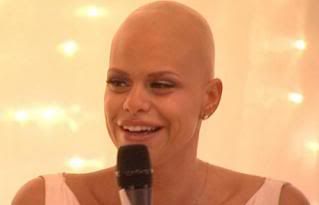
We crucified the woman for her greed, but we chose to ignore she had a deprived childhood and she was a mother to two young sons, to whom she wished to give the type of education her family could never have afforded for her. How can any of us judge her for the dignity-for-cash deal she struck when she agreed to being photographed in hospital looking her worst, getting married bald and with false eyelashes because she had lost her own, then snapped dying, and now dead and being buried, all for the sake of granting a future denied to her for her own children. Are privacy and dignity such a high price for a mother to pay, when one is about to die leaving small children to be cared for?

Any schadenfreude people felt about her plight is inhuman and unjustified. Just because she was Britain’s first reality TV star, it does not mean her suffering was not real but a soap opera put on camera for our entertainment. By any standards, 27 years is too short a life.

If fame was what Jade craved for, she got more than she deserved. God knows how long the media will go on to portray her as cover story. We must remember how reports on the supposedly mysterious circumstances of Lady Di’s death boosts circulation figures every time Al Fayed mentions a conspiracy theory. I must agree with Stephen Fry when he calls Jade “a kind of Princess Di from the wrong side of the tracks.”

Google, the new BB?
This week the media is also awash with news on the public’s accusations of
Google for invasion of privacy through their Street View . It is the people who were photographed coming out of sex shops, being sick outside pubs or caught in a compromising position with a work colleague who are shouting the loudest. The majority is simply indignant that the photographs reveal the inside of their houses or their cars parked outside. Yet, we think nothing of logging onto Twitter to find out that Ashton Kutcher is lustfully watching wife Demi Moore iron his suit while wearing a bikini, and we log on to Facebook where it is revealed our colleague has a raging hangover because he/she had a rough night out. Next BBC Breaking News flashes on our screen to tell us a Labour MP was caught having a romp in the House of Commons.

We seem to alternate between enjoying being voyeurs and self-righteous critics of voyeurism. We are fascinated by details of other people’s diseases, sex lives and affairs and yet we do not want our house to appear in a photograph of our street. How contradictory is that?

Peeping tom
Social media, and I daresay the advent of Twitter in particular, has made it possible to “follow” what is going on every minute of every day of celebrities such as the popular twitterers
Stephen Fry and Jonathan Ross all the way to President Obama. Talk about six degrees of separation. Separation has long ceased to exist. And it certainly does not take six people any more in order to reach that elusive “stranger”. One search and one click later you are there – knowing what Barack had for breakfast, if only he decides to “tweet” about it.


It is freaky to think I can “follow” the American President or the Prime Minister of Britain or a TV celebrity anywhere in the world as if I were a cyber-stalker, and all of that lawfully and without shame. Following what other people are doing and thinking, sharing their holiday pictures in Twitterpic or in Flickr are now routine and perfectly normal. What do you mean privacy? And you don’t want your new couch to appear on Google just because you hadn’t twitted about it yet?

Moi moi moi...
The truth is we currently live in a “me-centred” society, and we are obsessed about publicising our private thoughts and lives as well as scrutinising those of others. Not everyone uses social networking sites for voyeuristic purposes of course, but when I was being trained as a journalist we were encouraged to make active use of Facebook and Twitter as a quick source of information and news. In other words: if the door is half open anyway, eavesdrop at will.

Many of those who are suing Google because they appear in Street View putting the rubbish out in a nightgown and their hair in curlers will not think twice about looking up on the Internet for more details about a celebrity’s life, or death. They may even have bought the Jade tribute issue of Ok!

We have become so auto-centric and callous that as long as what WE want to protect remains protected the rest does not seem to matter.

Every time I read about “publicist Max Clifford” having called Jade’s funeral a “Jade Goodie production” I cringe, and feel like wishing he were a woman with a cancer-ridden cervix. While poor Jade lies dead in a morgue, his coffers fatten up with each paper sold. Were Max to be caught by the tabloids on his way to a Nazi orgy party like his namesake in Formula One, he may not find the front cover story so entertaining.

The world goes on – without Natasha, without Jade. We will carry on scrutinising, googling, eavesdropping. Nothing changes overnight. In my heart I wish the two celebrities a long, deep sleep, away from the flash of the cameras and basking in the Light that embraces those lain to rest in peace.

R.I.P.

Labels: , , , , , , , , ,